
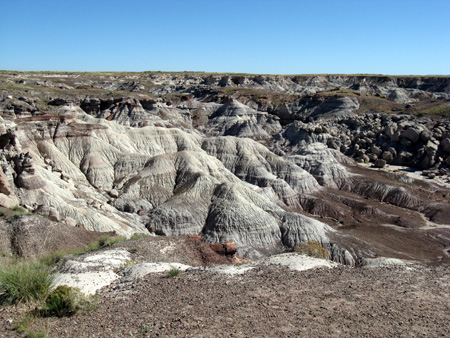
Blue Mesa Badlands, Petrified National Forest, 2010.
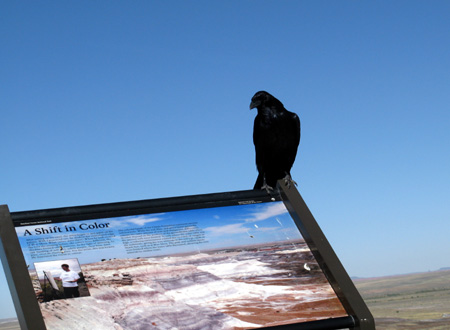
Having survived the demos, I am taking the day off from painting. Which didn’t exactly mean sleeping in. We got up at our usual time, but this morning, instead of pulling myself up and pulling things together and pulling myself to the car to get to the painting place before the light changed, I made a cup of coffee and meandered around the deserted, cool complex of Visitor Center, Science Center, visiting VIP apartments and some real living quarters.
The tourists who climbed out of their cars all looked a bit grim at 7:43. I sympathized, silently. No one wanted a cheery greeting.
The birds were noisy enough to drown out the noise of the freeway, and far more pleasant too. I stood on a human-made hillock hill that separates the Visitor’s Plaza from the living quarters until my ankles started to itch (ants? desert stick-to-ums?) and then meandered through the Plaza, around the parking lot (eyeing the few cars that grumpily were entering) and back to the back of the maintenance area, where the birds were carrying on and no one at all was in sight.
I am fascinated by human activity within spaces, although I know nothing about the science or research of such. But artists are observers, and I find myself observing what happens when humans are observing or partaking in “nature” — although what we think of as natural is often just over grown human artifacts. I think I may have to start painting “real” landscapes, not just wacky cityscapes, where people are impossible to avoid, but landscapes that include people and their artifacts.
It would be easy to be caustic about the tourists (I have been so, even as I am one myself). But that’s not what I want. What I want is to examine, with paint, what people do faced with the Painted Desert or Petrified Wood. Or Mt Tabor or Colonel Summers Park. How they use the natural stuff around them, what they avoid, where they make paths, when they flee it and when they embrace it. “Landscapes” that include telephone poles and signs and humans as well as the natural elements that normally define the genre.
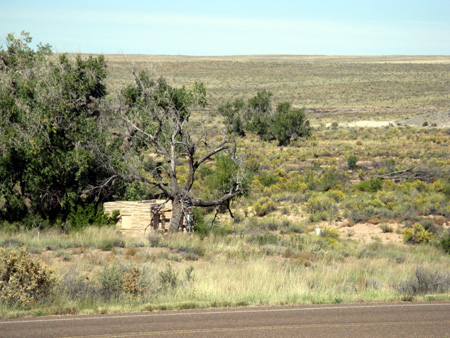 [Deserted Park building, possibly an old outhouse.]
All this maundering has been engendered by a thoroughly academic article that I only understand about a quarter of that I am reading on my Kindle, a panel discussion, led by James Elkins, that included a host of folks from all kinds of disciplines. I shall include the name of it later (Jer wants to go get some ice cream right now).
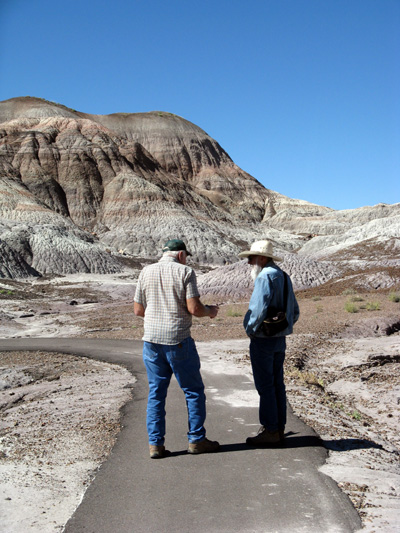
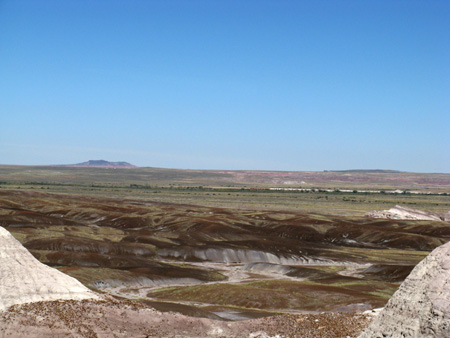 This photo, taken from the Blue Mesa Trail, includes, if you look closely, a train crossing the short prairie grass of the upper Bidahochi mesa as well as a couple of trucks (sorry, you can’t see them at this resolution) beyond the trains, traveling down I-40. We were standing on a steep asphalt trail (obviously made in part by machine) in the midst of wicked badlands (see the first photo). Below us were braided dry washes and conglomerate stuck in bentonite clay as well as steep washes filled with petrified wood. In the far distance is my own personal landmark, painted as an icon of natural landscape, Pilot Rock. But it too takes on human meaning, as a way of defining where the surveyor/explorer/pioneer/gold seeker was in the undifferentiated Colorado Plateau area.
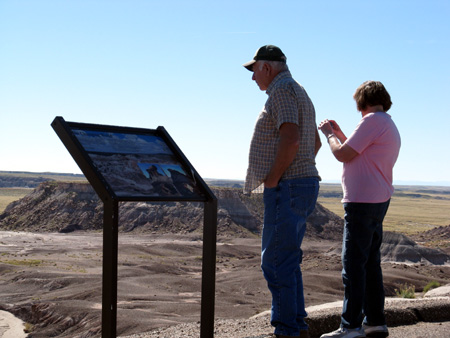
So following are a number of human/natural interface photos, ones I took this morning, while thinking about what we landscape painters ignore as we imitate the Impressionists. My memory of the Impressionists is, of course, that they included the human as well as the natural, but to us, now, those scenes seem fairly romantic, a time passed for which we can wax nostalgic. They are “landscape” to us, as telephone poles are not.
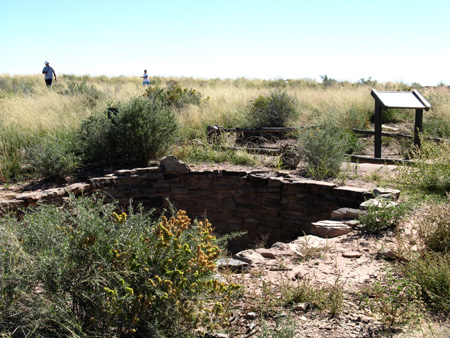 [The Puerco Kiva with sign and folks]
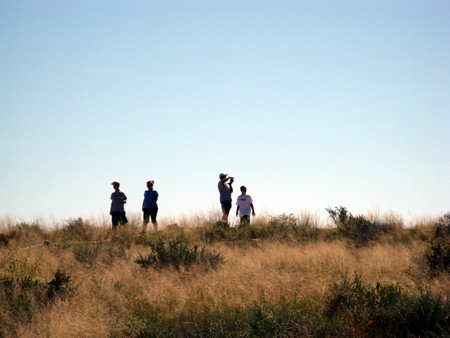 This last photo reminds me of scenes from western movies, all fake, of course, of horsemen riding across ridges (sitting ducks for attacking Native Americans, methinks). These folks are more benign and in little danger of anything but sunburn. You might also notice that everyone has cameras.
Tomorrow we are on the road, to Gallup, on the way to de Maria’s Lightning Field. –June
 juneunderwood.com
One response to “Petrified Forest Residency, Day 14, Oct 9, 2010”
Over the years, I have been drawn to the remnants of human presence in landscapes. I take many photos of ruins, deserted farmsteads, collapsed barns, and the like.
However, I took a number of photos the other day that I would have normally avoided, with living humans in my beautiful state park landscape. If nothing else, it certainly does help illustrate scale.