
Where do I start? One day is much like another, only different, and each day seems to bring new revelations. At least each does when I’m paying attention.
This morning, I worked over that central panel, again. I realized that, as it was painted, it looked as if a gap existed between the mountains — where none in reality exists. That’s because I was painting those north facing mountains that are so hard to see. They basically got slopped into some sort of shape, but not really observed.
So, I got to do my dance from wall to door to wall to door, dripping paint as I sallied forth, again and again and again. In the end (about noon) I was satisfied at last that what I’ve been calling The Long Slope, which never shows its definition, was about as good as it would get. I had properly closed the gap in the center panel, which shouldn’t have been there to begin with.
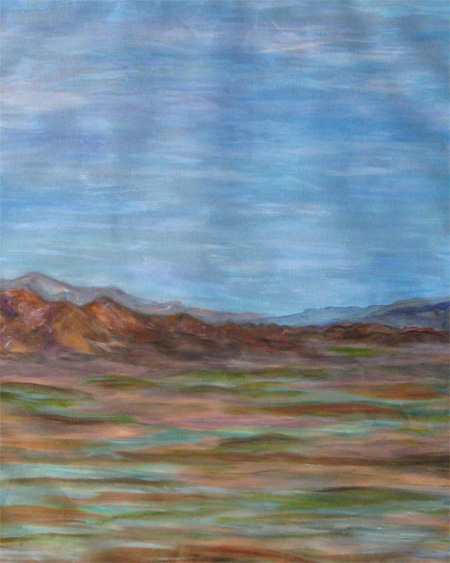 Linen Panel #4, November 23, 2009
But more important than dealing with the mountains was another insight crept slowly but surely into my consciousness as the morning progressed.
Late yesterday Jer and I drove west on a gravel road that ultimately turned north. We were driving along the Bullfrog Hills, which jumble themselves crossways between the big ranges, Bare Mountain and the Grapevine Range. These are the hills that cuddle Rhyolite, the ghost town up the road, and one of which is directly behind the Red Barn studio. They continue, in a kind of informal, helter-skelter way until they bump into the Grapevine mountains, the range that runs pretty much north and south along Death Valley.
I was tired and not paying much attention to the scenery, when Jer stopped to take a photo. As I sat looking out the front window of the car, I suddenly realized I was seeing what was, for me, totally new and unknown territory, the kind of thing that can give a tired mind a bit of frisson, a little anxiety about being way out beyond the known. I got out of the car then and looked back down the road we had traveled for the last half hour. There was the whole of the Amargosa Valley, looking the same as ever, just like it did when I stood in open doors of the Barn. Oh there were some differences I could count up, but really, after going far west and far north, we were still in the Amargosa Desert.
Which brings me to my revelation. While the Amargosa Desert and the Amargosa Valley converge down around Beatty, the Amargosa Desert goes north and west, staying between the Bare Mountains and the Grapevines until it bumps into the Bullfrog hills. The Amargosa Valley, however, with its trickle of a river, has come directly from the north through the gap between the Bullfrogs and Bare Mountains. It has its origins in Oasis Valley, coming out the Timber Range, farther east than the Bare Mountains.
The desert is a much bigger, more open, vaster space than the valley. The far right panels of mountains that I had been painting were still very much a part of the desert that is seen in the first, far left panel; the valley only exists in the first two panels.
What this did to my head — and hence to the painting — was make me realize that I had to pull that desert sense clear across all the panels — not just allow the mountains to draw nearer but to continue the desert fully into the space. The Red Barn does not exist at the head of the Amargosa Desert, although it’s close to the head of the Amargosa Valley.
So, with this insight becoming more and more clear to me, I recognized how I could deal with another problem that had been bugging me. The panel (#2) with the gap in the mountains where the Amargosa River goes through them had been painted early and was a pretty good panel. Too good, in fact. Its brightness drew the eye in ways that I didn’t want but I couldn’t bring myself to do anything about. I didn’t know what I would do with that panel if it didn’t go so glowingly into the distance:
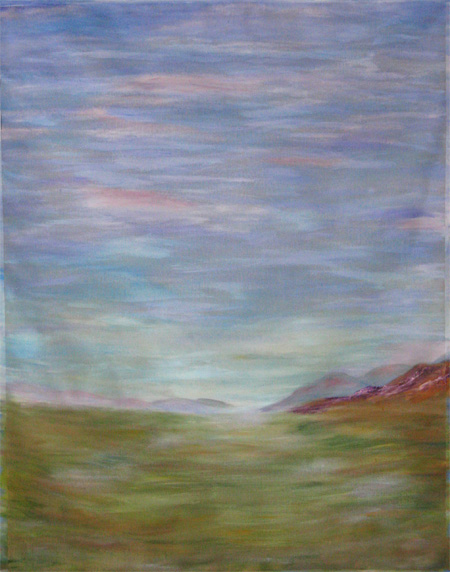 This is Linen panel #2, November 20, 2009
And here’s the change that I made to it:
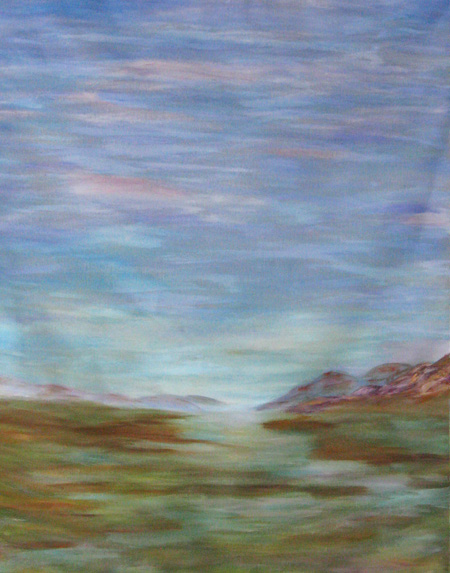 Linen Panel #2 November 23, 2009
What I want is for the desert to go west, not south. So here’s something of what I did with the panels to the west of #2:
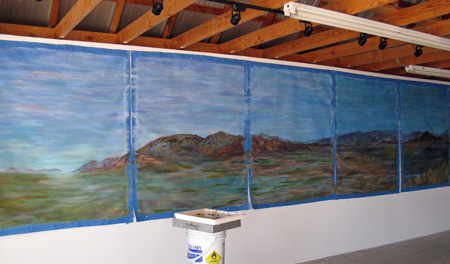 Panels 2, 3, 4, and 5, November 23, 2009
Another view:
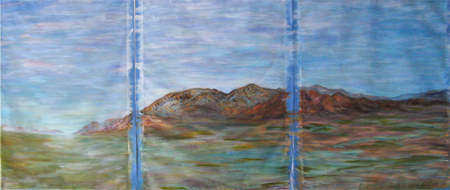 Panels 2, 3, and 4, November 23, 2009
My hope is to push the color west (right) instead of having it pull the eye totally into the center of panel 2. That will (I say, crossing my fingers) pull the viewer’s eye across the panels rather than stopping with panel 2. Moreover, the flatness of the center panel (more mottled than yesterday but still without much depth) makes sense as a flat desert “void,” not trending much of anywhere. Just there. The color will continue on, but the width of panel 4 flattens the space.
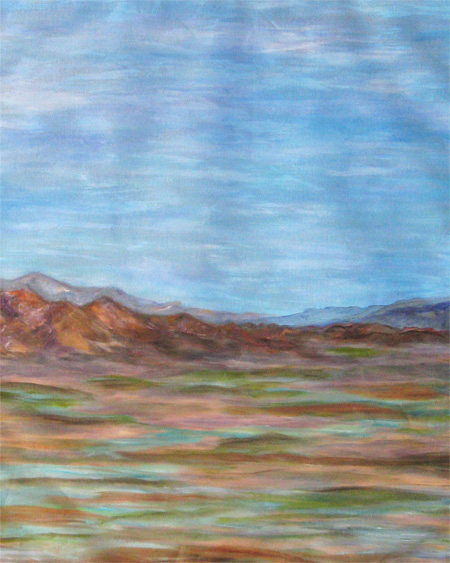
Linen Panel #4 November 23, 2009
I’m not sure this is making any sense to anyone but myself. But recognizing the difference between the vastness of the desert and the small part of it that makes up the valley made me see the space that I was painting differently. Driving along the Bullfrog Hills, into territory that looked totally unlike any I had seen, and then looking back at the absolutely familiar space of my quotidian told me that I had been painting as if I were the center of the universe. Now I’ve know, viscerally, that the universe of the Amargosa Desert goes far beyond me and my eyesight. So should my painting give, at least hints, that there’s more.
And of course, More Must Be Done. Reporting from Goldwell House, Beatty, Nevada.
And a postscript: to be fair to my own inaccurate perception, I grew up in the Susquehanna Valley beside the Susquehanna River, and I now live in the Willamette Valley, 14 blocks or so from the Willamette River. These Valleys are distinct entities, carved, in part, by their rivers. The Amargosa Desert was created by the earth pulling the continent apart; the water that drifts down part of it just happened to find a low spot and sink there, temporarily. It reappears at the south end of the valley, makes a sharp turn north, and sinks, permanently, into Death Valley. Unoriented space, that’s what I calls it.
 juneunderwood.com
3 responses to “Another Direction: Day 23, Nov. 23, 2009”
Love the description of the “aha!” moment. I enjoyed that kind of discovery when I lived around Dayville.
I am getting a sense of Monet’s waterlilies, oddly enough, but I think this is a good thing. I am seeing subleties in color that I haven’t seen before. Nice! Looking forward to seeing the real thing.
Thanks, Lia, for checking in.
And Terry, it’s interesting that someone in Beatty brought me the big book of Monet (one of the coffee table variety) because he thought what I was doing looked familiar. Having said that, I realize that it was Nov 23 when I published these photos and much has changed since then. I don’t know if I kept the monet look or not. It never was intentional, for sure.