
Last evening in a comment on Art and Perception, Birgit spoke about “pure” and “mixed” oil pigments. I was shocked!
I know about “pure” dye powders and mixtures, and although when I was dyeing fabric I sometimes succumbed to the temptations of the mixtures, I was well aware that I was doing so. The problem with mixtures is that they can create mud. With dyes this becomes quickly apparent – put 3 dyes together, one of which is a mixture and the result is often yucky. However, I hadn’t realized it was also the case with pigment. With oils, when you get mud you can sometimes just scrape it down and start over (unlike dyed fabric), but with the linen panels I’m using, scraping is not only inefficient, it doesn’t work as well as I would like. To cover the old paint I have to resort to opaques, generally white, which then doesn’t blend well with the brownish-beige of the linen itself.
So, I am now looking at my painting tubes, some of which tell me what’s in the tube and some of which don’t. The names of oil paints like Terre Verte and Sap Green, which I’ve come to love, are, as Birgit’s research showed, likely to be quite different in different brands. They are also sometimes mixed pigment where one expects a single element. You’d think terre verte was a kind of green dust, but not so. So much for my faith in tradition and oil painting.
However, even with a new conundrum, it was a productive day. Only one visitor appeared and I took no long desert walks (I did a short stroll, but that didn’t count). I began by doing a study for panel 3, on board, and then realized that I had to match it to the already underway panel 2. The process definitely improved panel 2, but I can see even more that I will do to it. It’s the first board panel I did and has more reworking than the other two. Maybe my eyesight (or insight) is improving, since the later ones got better.
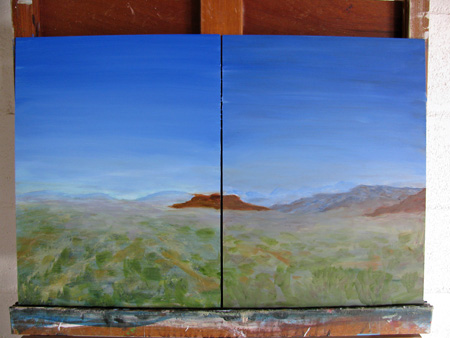 These look a bit strange, but trust me, they are coming along. It was the foreground that got improved in panel 2 (on the left). The dissection of the middle form will fall into place when the panels are reworked as I envision (or do I mean if I can rework them as I envision?)
Board Panel #7 won’t get reworked until I get to the end, since I want these to line up panoramically, just as the linen canvases shall.
Here’s the last photo of the day showing the 4 linen panels that I’ve now arrived at. Today I managed to rework a bit of # 2 and 3 and got a good start on #4.
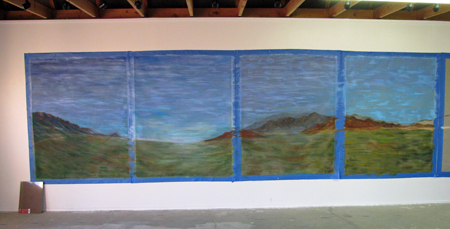 Panel 3 actually gave me fits (panel 4 isn’t far enough along yet to start me cussin’). It turns out that not only does the desert light change constantly and effect what you can see and what colors the forms take when it changes, but the simple act of walking from one side of the two open Barn doors to the other side changes what can be seen.
I worked on a board study early in the day.
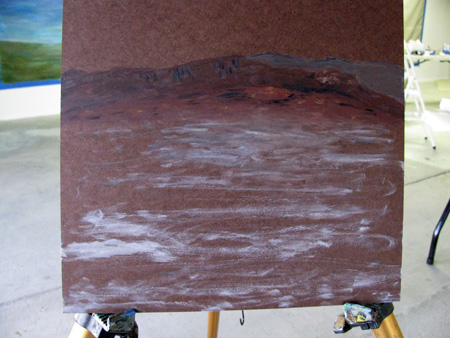 (Study for Long Slope, linen panel #5)
As I worked it from the left side of the doors, I realized that I could see the mountain forms for panel 3, so I dropped work on the board and walked to the other side of the room, where the linen panels are tacked to the wall. I blocked out what I remembered of the forms and then went back to the door (on the right side) to check on them. But what I had seen as two mountains, stacked and with the usual layer of atmosphere, had disappeared. There was but a single form. I puzzled over that, cleaned my glasses, put them on and off, and decided I must have been mistaken. There was but one mountain there.
Some time later, after I had that single mountain painted on the linen, I walked to the other (left) side of the open doors, near the earlier study. And there they were, the two mountains. I was not hallucinating. The difference of perhaps 20 feet made the difference between seeing one mountain and two.
Needless to say, two mountains are contained in the background of Panel 3, along with the red forms that are so prominent when the light is right — “right” depending on whether you want color or shadow.
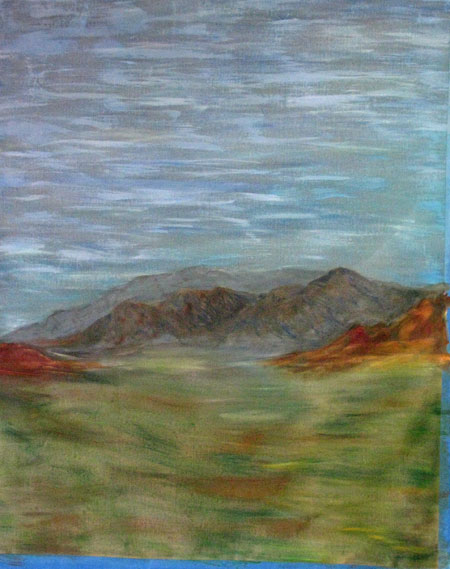 Panel 3 got further work as the sun went into the west and I discovered the ridges ran northwest rather than southeast. The western shadows showed them up clearly and I dashed around the form, re-orienting the direction of the ridges.
And, as Papa Cezanne pointed out, the whole painting needs to be worked simultaneously, even though that’s out of my range of abilities. So I had to rework where the panels come together and the changing of temperature/color of the skies across the linen — it’s a whole lot easier on board than on linen, believe me.
So here are closer looks at Panels 2 and 4, which straddle #3 above. And also a photo of what awaits me. Taking Cezanne’s advice I at least outlined a bit of the largest forms that are to follow along the panels, hoping not to go too far astray.
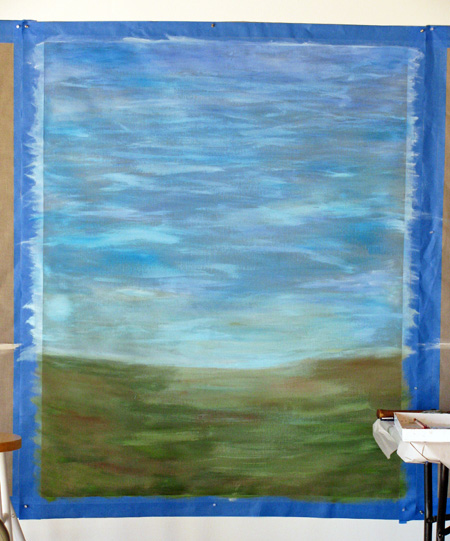
Linen panel 2, Day 8
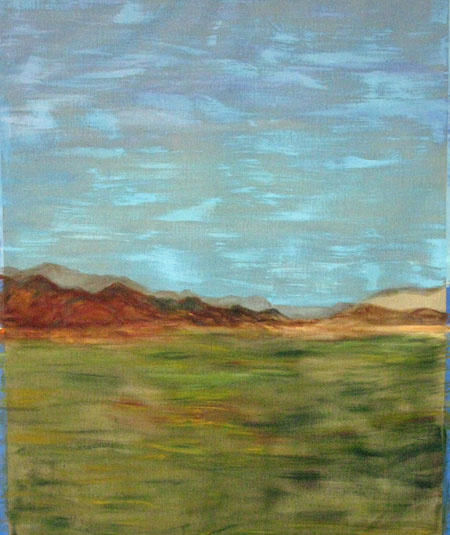
Linen Panel 4, day 8
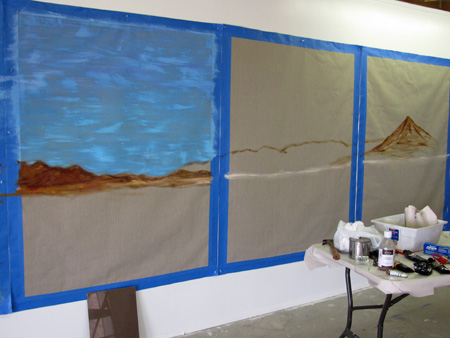
This last photo was taken at mid-day, (day eight) before I had begun work on the bottom of panel 4. These are panels 4, 5, and 6, in which I am trying desperately to incorporate Papa C’s advice about working everything at once.
Reported from Beatty, Nevada, which has heavenly avocados at this time of year.
 juneunderwood.com
2 responses to “Pigments, Placements and Papa Cezanne, Day 8, Nov. 8, 2009”
I am in awe of what you are doing.
You are amazingly fast to respond. I think I just posted this about ten minutes ago (right before I wrote about the IPod:-)) Thanks for the comment. Today things went pretty well, considering…