
begins with a first step:
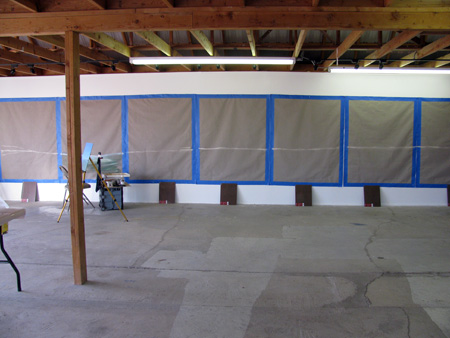
That white line on the set of canvases? It’s the “horizon” — of the basin, not of the ranges that bound it NW and SE, nor of the far distant ones that seem to bound the far southern end of the Amargosa. But sorting out the boundary of the basin allows other parts of the project to become delineated.
In Portland, I imagined an “unoriented” spatial experience, but as I prepare to paint, I’m doing more orientation than I ever imagined. Not just geographical and geological, but also light and color, ratios and cheats. And I’m of course doing studies and sketches.
I began the day by working further the masonite panel, study for #2, the furthest and lowest part of the seven panel set. The small masonite study is looking somewhat better and is certainly a relief from the gessoed linen.
Then I moved to the back wall, seven panel gessoed linen sampler, where I lowered the horizon — and then lowered it, two hours later, again. This muckled (some might say muddied) up my colors, but clarified my thinking about that Basin horizon.
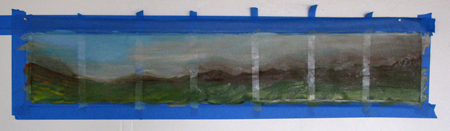 Impossible for anyone but the artist to discern what’s happening on that back wall now. And I was so pleased with the way the colors were working on the second pass through. Darn.
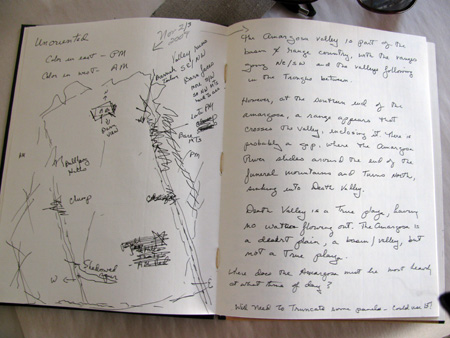
It was while I was doing the faux-pleasing sampler that I worked out my most simple light/hue questions. The panels move from east (left) to west (right). But the sun in the evening is best as it illuminates the eastern mountains (the Bare Range); the morning sun is best for the western mountains (the Funerals and Grapevines). So PM light will be in the east and the AM light in the west. Are you disoriented yet? AM light is cool; PM light is warm. The light in the furthest distance varies so radically and erratically during the day that I think I’ll just make it beautiful, whatever temperature that turns out to be. A couple of western mountains, a spur and a small cluster in front of the main ranges, actually have great shadows in the evening, so they are going to get the PM Treatment regardless of the general scheme of things.
In addition, I’ve been reading the Henri Art Magazine Website and something the author (unidentified by name) said made me think about the nature of the color of shadows: not just that they have color, taken from the local undercolor on which they lay, but the color they take is the complimentary of the feature that is shadowed. And it has the opposite temperature. Got that?
So the warm, golden hued and cerulean blue eastern Bare Mountains (warm because they are in evening light) will have purple/green and orange tinges in their cool shadows.
I wrote all this down in my handsome notebook, which is filling up with my unhandsome handwriting:
And then, having procrastinated as long as I possibly could, I had to start the big canvases. I found the wax paper and a tub for my initial Big Panel palette (having filled a smaller palette with paint for the back wall sketching):
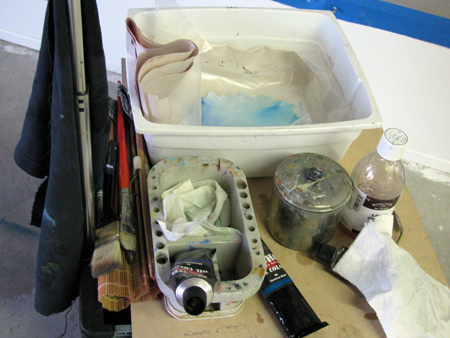
I filled the “palette” with titanium white and a tint of (what Soho calls burnt sienna but is really) a raw umber, along with some cerulean and ultramarine blue. I got a big brush, and I drew that long line.
By the time Jer came to pick me up, I had gotten most of the canvas smeared with some paint:
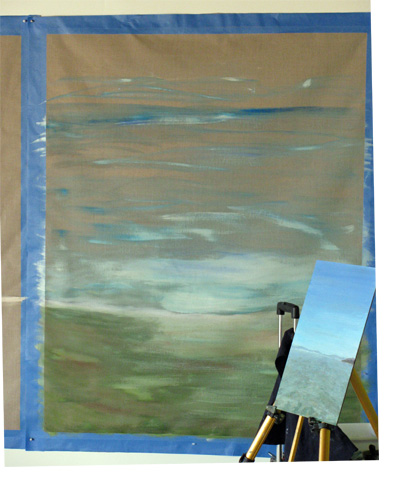 Tomorrow I will finish the small masonite study, start a masonite study for another of the big canvases (one that shows up properly in whatever time of day it happens to be) and continue to put paint, lots and lots of paint, on canvas panel number two (the one pictured above). I actually got more paint on #2 after I took the photo, but by that time, my brain couldn’t coordinate with my thoughts or my camera, so this is along the way but not quite to the end of the day. I wasn’t quite dancing, but I was moving my arms as if they were windmills. I think the dance comes later.
Reported from the Goldwell Open Air Art Museum, Goldwell House, Beatty, Nevada, 220 miles south of Reno and 110 miles north of Las Vegas.
 juneunderwood.com
2 responses to “Every Long Journey (and Big Canvas)”
I am loving reading your journal. I was fascinated by the info. about shadows, and by the coincidence of my having ordered only today the book In praise of shadows by Jun’ichiro Tanizaki.
I’m so glad you are able to follow and even check in, Olga. The book sounds fascinating. I’m going a bit bonkers with the changing shadows on the desert — the sun is so strong and it seems to move so quickly that getting a fix on it is much more difficult than in the diffuse climate of Portland. But I do love the challenge. And no one can accuse me of not capturing “reality.” After all, it just changed…….
I’m going to check out In Praise of Shadows and see if I need to haul it back home with me (ie, do I need to order it today to read here?)