
It was cloudy at 8 AM when we started off to the Painted Hills, an earlier day than yesterday. I was ready to finish off an already composed painting. The early start and muted sun turned out to be advantageous for capturing the color of the Hills. And the skies, full of clouds and Moran-like sun rays, were quite glorious in themselves.
Of course, I first had to pull my cart up the trail and set up space to finish the landscape I started yesterday.
As I said, I had become enraptured by the disorganized state of the hillocks and hill that surround the basins of colored clays and ash. The higher lands that surround the Painted Hills have typical desert foliage — sage, rabbit brush, bunch grass, western juniper and cheat grass — but they don’t follow ridges. The volcanic plugs left over after millions of years of erosion stick up willy-nilly, all around, slightly eroded to kindergarten- like mountain shapes.
And in the midst of them are the basin badlands, colorful, without a hair of foliage, pocked by rain and sun; and beyond the lumpy hills and hillocks is Sutton Mountain, an elongated uplift, with a hard rock cap, looking the way mountains should look.
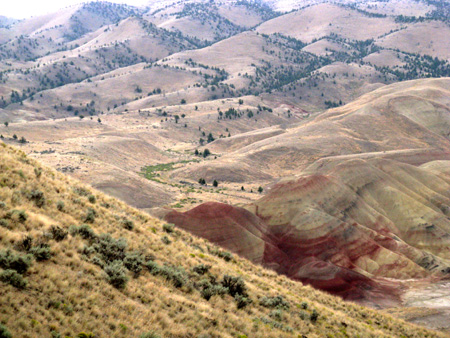
This description, merely an extension of the one I gave yesterday, is important because it became a base for thinking about the painting I completed (tentatively) today. The bumpy hills, gaining height but not necessarily organization as they march into the distance, felt more important to me for this painting than the badlands with their colorful striations. But the badlands are warm in temperature — gold and red — while the hills are cool with sage and juniper and distance. To emphasize them would reverse the usual focus — warm takes precedent over cool, near takes precedence over far.
So while yesterday I kept close tabs on planes and shapes, today I kept thinking about color temperature. Elizabeth Barton has a recent blog post on color temperature; reading it last night I was reminded,as she says, “color is complex dish.” As usual, (my) reality doesn’t fit the theories as nicely as one would like. Because the badlands are closer, they, warm in hue, loom toward the viewer and are equal in size and stature with the distant, cooler hills. So Elizabeth’s guideline about sticking with one temperature over the whole canvas rather than evenly (or randomly) distributing the warm/cool caused some difficulty in actual production. I wanted those cool distant hills to be the focus of attention.
It is certainly the case that a painting that has a preponderance of one temperature is more soothing, less ruffling to the viewer’s eye. Changing color temps can make the eye bounce around, make a kind of jittery dis-ease. Elizabeth’s words were “weird and unsettling.”
Which gets me to my canoodling point: I’m seldom a painter of soothing scenes. Neither my temperament nor my disposition makes me want to sing lullabies or make objects which don’t bring the viewer to a slight shake of her head. So I tried, in this painting, to bring the distant cools, in their disorganized lumpish shapes, as most singly important, while being true to the apparent space and necessary hues in the landscape. I kept the cools behind, putting the warms in front. But I squeezed the actual space into a slightly more vertical alignment, hence elaborating on those cool distant mountains.
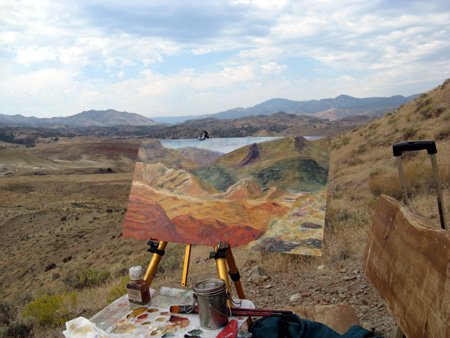
We’ll see how this painting holds up when it gets back to level land.
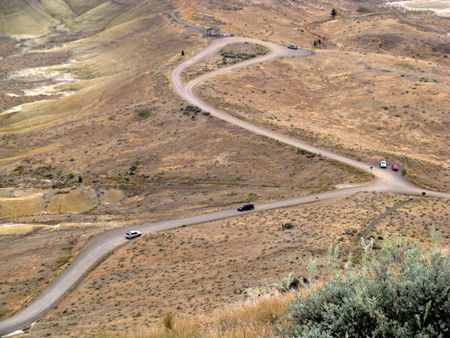
The rest of the morning was spent hiking the Carroll Rim Trail to the top. We left the painting gear at the lower bench, knowing it would be safe from humans (because in my two days, not a single human came up the trail. The greatest activity of a human sort was a “traffic jam” on the graveled park road: the photo below, of the “excessive” vehicle use, was taken from my painting spot.)
The trail is an easy 3/4 of a mile hike to the top of Carroll Rim, a basalt-ish outcrop that marks a ridgeline along the top of the hill from which I had been painting. The scene from up there was even more spectacular — and definitely more unpaintable.
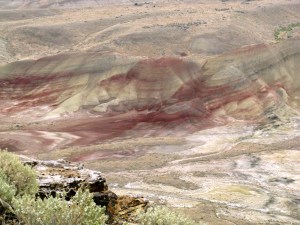
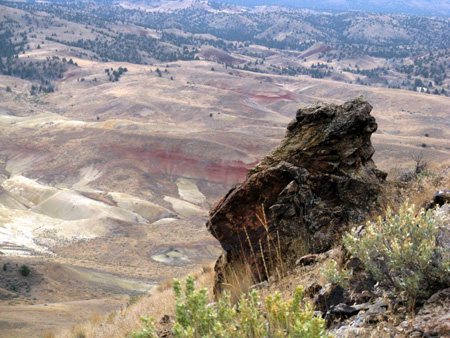
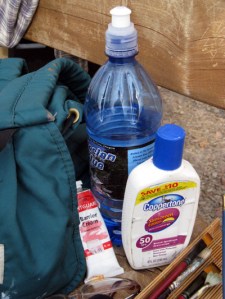
And so, having finished out this day’s visual feast we went back down the trail, gathered up the essential liquids and painting gear, and went off to lunch — not quite as glorious a feast, but more desirable at that point.
Tomorrow it’s to Sheep Rock and the Condon Interpretive Center, 80 miles or so down the road. Sheep Rock is eminently paintable — I’ve already done so on prior trips. Maybe instead I’ll paint some version of the barns at the historic Cant Ranch site. I’d like to see the interiors of them, but that probably isn’t going to happen.
Or maybe I’ll stroll around and scare the rattlesnakes. –June
 juneunderwood.com