Petrified Forest, October 1, 2010
Off we went, late this morning – 6:30 rather than 6 AM. The ranger had already opened the gates and moved on. Some mornings we have arrived before he did (we have a key to open the gates ourselves). Other mornings we arrived just as he did, and he got to deal with the ornery locks. But this morning, the road was wide open, nary a soul in sight.
Which is how it remained as I painted until past 8 AM when the tourists began arriving. I painted today at the Puerco Pueblo site, which overlooks the Puerco River, about eight miles south of the northern Park entrance. There I painted the River first and the excavated Pueblo remains second.
The first painting shows the river — as you would know it was there but not see it – that is, without water, just a line of green trees moseying in a river- like fashion. The Puerco is dry a lot of the time, although we arrived shortly after a monsoon rain had made it a muddy meandering flat. But by today, a week later, it was almost dry again.
The painting is really a color study, appropriate enough in something called the Painted Desert. The early morning sun washed across the tops of the meadowy grasses, blinked at the gray greens of the river trees and fell lightly on the hills beyond. I was on a hill myself, overlooking the declivity (arroyo? wash? valley?) in which the Puerco sometimes flows.
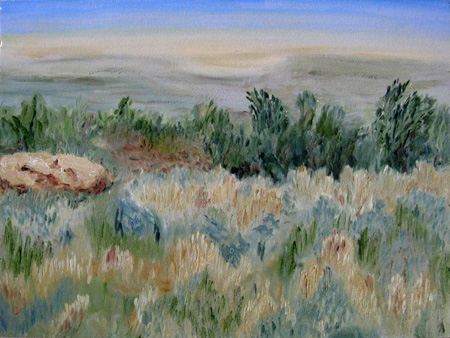
The Puerco River in the Petrified Forest Park, 12 x 16″, oil on masonite, 2010
An amazing amount of grass grows in parts of this Park, which also contains amazing amounts of badlands which are made of bentonite clay, which contracts and expands in such a way that no foliage at all can gain a foothold. But this particular slice of parkland is like a shortgrass prairie, albeit having lots of stony remains of the pueblos that were here in 1200/1300 AD.
Puerco means “pig” in Spanish, but its earlier etymology was something closer to “dirty” or “messy.” The Puerco isn’t a clear mountain stream, but rather a meandering body of brown mud that carries eroded materials into the Little Colorado which flows into the big Colorado. It also provides a source of water for cottonwoods and other green growing things.
I am using masonite boards for these paintings, and have discovered some interesting, mostly useful, traits of my supplies. Just before we were to leave for Arizona I discovered I didn’t have enough boards. I went to every art store in town, gathering any 1/8 inch masonite board which had 12 inches on one of its sides: these would fit into the plein air boxes that I’ve accumulated. (I have 12 x 12 inch boards, 12 x 16 inch boards, and 12 x 24 inch boards.) Because they were gathered variously, some were Ampersand Gessoboard with the Ampersand white gesso finish. Others were Ampersand without any gesso. Others were other brands, mostly without gesso.
I spent a couple of days before we left gessoing the boards, in varying colors (it’s helpful to have some initial color on the boards to modify the stark desert sun). I ran out of time before I gessoed all of them, but as is often the case with my unmethodical approach to things, some I gessoed with a paint brush and some with a roller.
It turns out that in the dry desert heat and sun that even oil paint turns tacky rather quickly. The boards on which the gesso was rolled have tiny raised dots, as a rolled surface will, and I can use those dots to scumble across the tacky surfaces of my underlayers of paint. This gives a greater depth to something like the distant colors, which are almost but not quite smooth and flat. Just a fun observation – at least this morning it was fun. The other day, I didn’t want that bumpy effect, and it was a great deal less fun. I am unmethodical in my choice of boards at 6 AM, so what I grab from the pile to work with is what I work with. It make painting interesting.
After finishing the color study, I knew I had to tackle the Puerco Pueblo remains themselves. Mostly the remains are just walls, the bases and partial sides of buildings that may have been six or seven feet tall. Like all the Pueblo buildings, they would have been entered from the top, with no side entrances. Most of the activity of the pueblo would have taken place outside, in the main communal courtyard. The Park service archaeologists excavated many of the rooms of this compound, but returned the soil to them; it’s the easiest way to preserve the for future study. They left enough stabilized walls open so we the tourists could more readily imagine what the full compound might have looked like.
Just beyond the line of rocks marking, in irregular heights, the Puebloan structures, is an unused, obsolete concrete block Park restroom, now closed off. My thought in choosing this place to paint is that the two structures, both human artifacts, would talk to one another. They don’t quite, in the painting as it now stands, because I need to reinforce visually the concrete block nature of the contemporary rest room a bit more. But by the time I had finished with this much of the painting, it was 10:30, time to close up shop before I fainted from the heat.
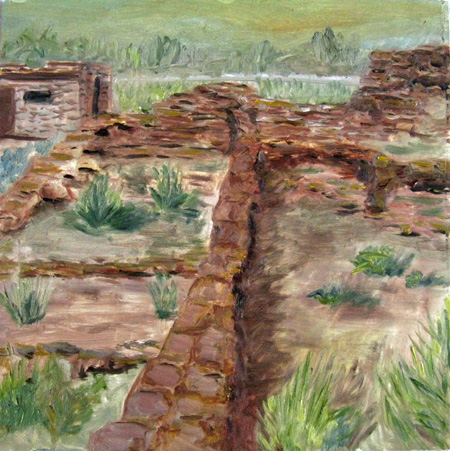 Puerco Pueblo Walls, 12 x 12″, oil on masonite, 2010
Jer arrived just as I finished and after stowing the gear in the car, he and I joined Sherry, a volunteer at the Park, on her tour of the Puerco Pueblo site, a tour which gave us further insights into why the people who settled here would have done so. They were farmers rather than hunter gatherers, and so they made permanent shelters rather than moving around. Sherry explained that deciding on a place to settle down depended upon a source of water, (which the river, but, more importantly, many nearby seeps) provided, shelter, available because of the easily chipped and shaped sandstone from which the buildings were made, and food, which had to come from farming, since only small or fast animals inhabited the area at that time. The other things needed was pottery, a bit of information I hadn’t guessed. Pots were essential to carry over the farming products through the winter, providing food and seed for the following year. The typical pots from these Puebloan people had small necks, which could be sealed against the mice and other animals.
I forgot to take many photos, except some of the human culture that this 800 year old settlement is surrounded by. I’m thinking that the next plein air gig I take on will definitely have to include a recording device. At 6:30 AM, bird sounds prevail, although some trains also get heard, as well as peepers, or little frogs. (I actually saw a quarter sized frog and got a photo of it), At 8, the tourists, speaking many languages, most of which I can’t guess the origin of, wander by. By ten or so, the vehicular traffic, big buses, trucks and RVs add to the sound track.So here’s the appropriate photo, with the line of cottonwoods along the Puerco River showing as part of the scene.
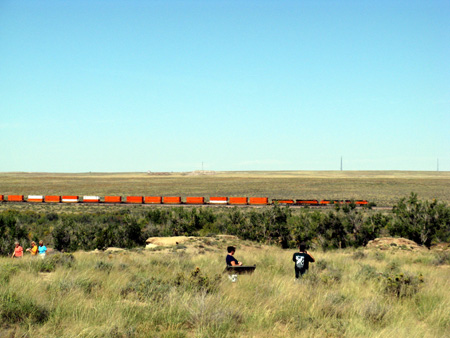 Obviously, poetic license dictated that I leave out the tourists, the train, and the cell tower from my pretty color study <snort>
Then we went back to our apartment, where we entered through the front door, we turned on the faucet to wash off the paint, heated up some coffee in the microwave, and poured out breakfast from the oatmeal box that we bought in Holbrook. No pottery in Apartment K, but food, shelter, and water, plenty.
Reported from Apt K, Petrified National Forest, Oct 1, 2010 –June
 juneunderwood.com
3 responses to “Petrified Forest Residency, Day 6, October 1, 2010”
I am in love with The Puerco River painting. In fact, I covet it.
It has the strong horizontals that I find very soothing, beautiful desert colors, and the vegetation is exactly what I envision when I think of this place. Just gorgeous.
Cynthia,
This is one of Jer’s favorites, too. I’m ambivalent. You are right that the strong horizontals as well as the pastels of the vegetation are what the desert shows so well. It does not, however, have the jagged edge of excitement that I tend to drift toward. Perhaps I should spend more time mellowing out here:-)
Thanks for checking in. And tomorrow (that is, Monday Oct. 4) I will be back at some more horizontal, mellow sites. Maybe, well, maybe, they will speak softly to me and I’ll respond in kind. On the other hand, the ravens are not mellow at all (at least in sound and color) and they speak often and loudly when I appear.
Love those cloud filled skies. It’s easy to see how Georgia was moved to paint bones against desert skies. You are doing so well to take on such humongous subject with so little time to absorb it.