
Windy March roared in like a lion today.
Not a lot to report. I added two rocks to my growing circle in the “yard.” It was wild and windy out, so I was glad to have decided to work inside at the Red Barn today. The tin roof sounded at times like it was coming loose, but it seemed to have held, at least until we left at 5 PM. I used the inside time to tweak some paintings and visit with an internet friend, Sharon Richards, who was passing through Beatty. I was glad not to be hanging onto my canvas and my hat in the wind.
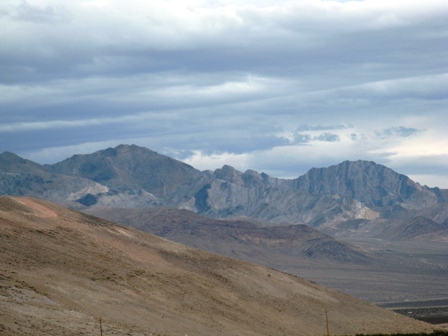 The Bare Mountains were spectacular with the storm clouds, although they’ve lost all their snow. The Funeral/Grapevine ranges, west bordering Death Valley, still show some.
So a couple of art observations that I made while I was comfy inside the rattling Barn:
In regions where the sky is vast, light from the sky becomes the element that determines color. In cloudy conditions and presumably in the early morning, the light turns things more blue; when the sun is shining or it’s near dusk, the hues are warmer. The direction of the light, north and south as well as time of day, also changes the colors dramatically, turning dull gray into glowing red, or dull beige into gold. A bit of shadow will change the color of the areas nearby; a streak of sunlight on a white talus slope will make a dull black a glowing green. The furthest mountains are of course, changed by atmosphere, but because here in the desert, the air is less watery and atmospheric; the colors, even at great distances, are more varied. This is, I might add, not so clearly the case with the Amargosa Valley to the south of the Red Barn, at least thus far in this residency. The Amargosa Valley isoften blue with atmospheric haze, which I attribute to its mostly hidden river. But even in the Valley as viewed from the Barn, the distances have to be great before atmosphere, as artists generally use it, is significant.
The second observation is that in working on-site, brush strokes can indicate a wealth of information that will be useful later. This is good to remember, since I almost always have to tweak in the studio, and knowing the direction of the landslides and talus slopes and mine tailings and bowl shapes provides the kind of variety that the land itself provides. Brush strokes are one way to indicate these elements, even when the base will be repainted later.
Third? Well, raw umber and davy’s gray both have blue undertones that get exaggerated when combined with titanium white. Terre verte, on the other hand, which looks a lot like davy’s gray, doesn’t have any and so is a better choice for lighter greens. Mixed with white, davy’s gray works well for sagebrush.
So before Sharon Richards appeared (and bought some postcards as well as bringing me some lovely bits of textile art) I tweaked two paintings:

Bonanza Mountain Backside, 12 x 16″, oil on board.
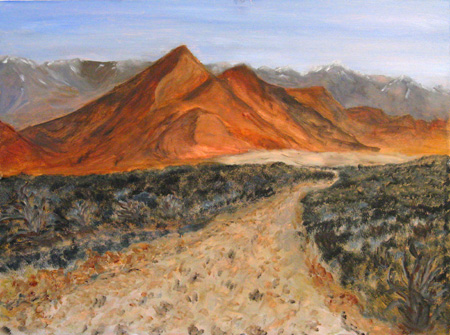 Bullfrog Mountains, 12 x 16″, oil on board, 2009.
These are the hills in front of the Funeral/Grapevine ranges, where Shorty Harris made his first discovery of gold.
I also did more painting on the panorama of the Rhyolite valley; the mountains are looking pretty good. The middle ground is a mess and the foreground doesn’t bear mentioning. It’s 18 x 36, so there’s lots of room for improvement.
Reporting from Beatty, Nevada, home of the Ensenada Restaurant, where deep fried stuff peppers are recommended. Some minutes off one’s life, but hey, I had a non-fat yogurt for lunch.
 juneunderwood.com
One response to “Diary of a Residency, Day 15, March 2, 2009”
[…] « Diary of a Residency, Day 13, February 28, 2009 Diary of a Residency, Day 15, March 2, 2009 […]