
This morning Jer drove me and my gear west from the Red Barn on the gravel road that begins where the pavement ends at the Barn. I had seen some volcanic cones in front of the Funeral/Grapevine Mountains, the mountains that define the eastern edge of Death Valley. The cones were red, unlike the ones I know in eastern Oregon, and I wanted to paint them.
As we traveled, we found ourselves at the backside of Bonanza Mountain. We hadn’t realized it had been mined in pyramid like terraces, much like the Barrick Mine on the main road (route 374) that goes to Death Valley.
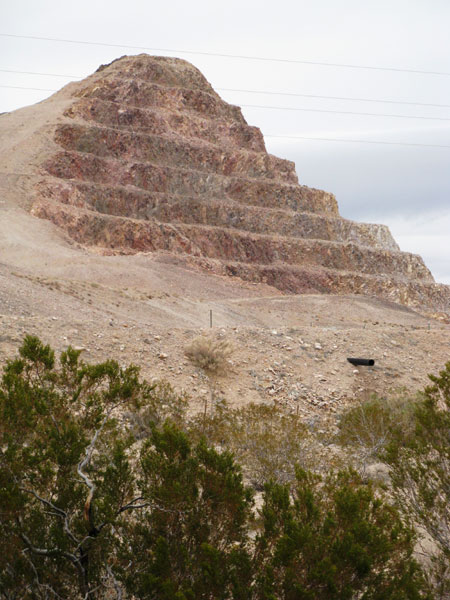 Above is the Barrick pyramid structure formed by the mining (vat leach process).
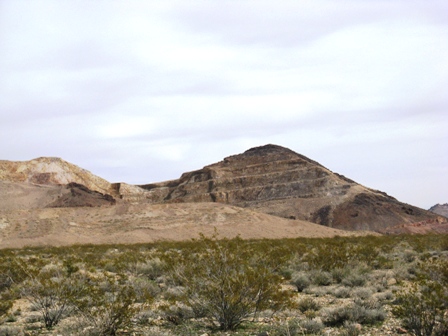 This is the backside of Bonanza Mountain, equally terraced. It demanded to be painted.
But first, I tackled the volcanic cones, just down the road from where the photo above was taken. I was a little less than a mile from the Red Barn, but I felt like I was within nothing human except that unearthly track across the desert.
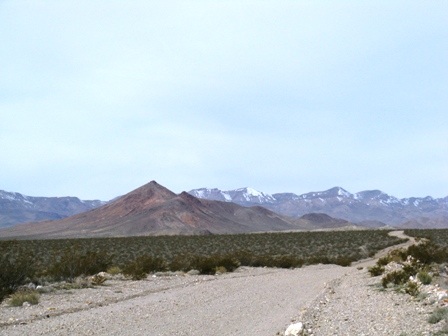 These are the cones I originally wanted to paint, as usual, diminished by the camera. We think they are the Bullfrog Mountains, and if so, they are where Shorty Harris, the father of all the mining in this area, found the first gold. Note the reddish color — great to paint with terra rosa pigment.
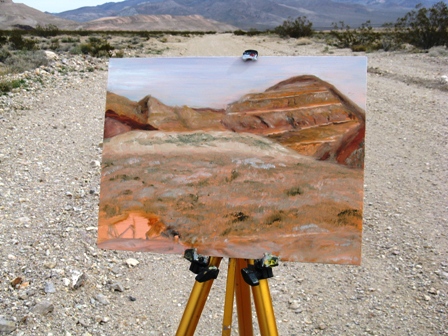
I thought I took a good photo of the painting I made of the Cones, but alas, I only have a rather poor one, in which the shadow of my hat shows, as well as the cones in the background. But since it’s all I have….
 The form of the mountains in the first draft isn’t quite right, but that’s easily fixed. The colors as I was painting in the overcast bright sun did the weird bluing out thing again, particularly when titanium white was mixed with raw umber. I think it’s the white that does it, although the reds and yellows seem to cancel the blue of the white. It looks different in the studio, but I failed to photograph it there. Tomorrow.
I still had energy left, so I turned my attention to the right, almost 180 degrees, back to the backside of Bonanza Mountains. The terraces cut by the mining are beautiful in a horrifying way. The tailings are enormous, and of course any leaching that pulls out the gold can put cyanide and other nasty metals into the soil unless it’s contained by vats. The natural scenery is scarred and tailing piles are enormous.
I am reminded of the W.B.Yeats poem about the Irish fight for independence called “Easter 1916”: the appropriate line — “A terrible beauty is born.” Yeats is commemorating the people who died in the rebellion, but the “terrible beauty” can surely be applied to the inhuman, yet beautiful works of humans — things like the tangles of interstates that curve into the air and distance — or the terraces that reveal the beauties of the rock within the earth. Sometimes we do horrifyingly beautiful things, creating a terrible beauty….
So I began to paint. I took photos of the various stages of this painting because I was so pleased by the hills that I worked before I began the sky or foreground. And I found another tool that I hadn’t used, a big blending brush that works well to lay in some ground before the plants are dotted on it. So here’s the stages of the painting, including a view of my plein air set-up.
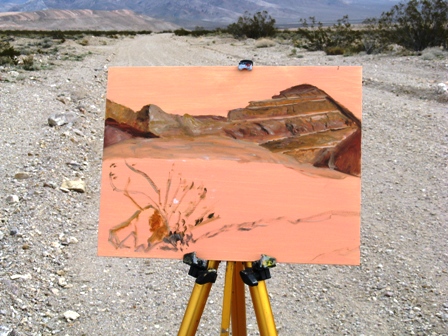
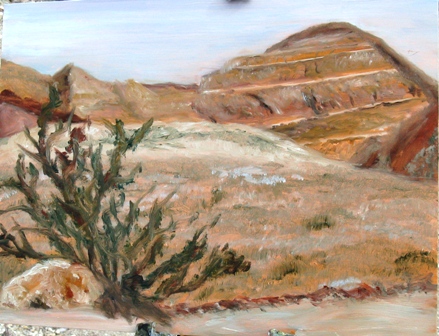
The last photo above, oil on board, 12 x 16, of the Backside of the Bonanza Mountain (draft 1) is close to being done. The light in which the photo was taken blued the whites a bit too much, so I’ll need to take another photo in the studio. And I want to diddle with the creosote bush a bit more.
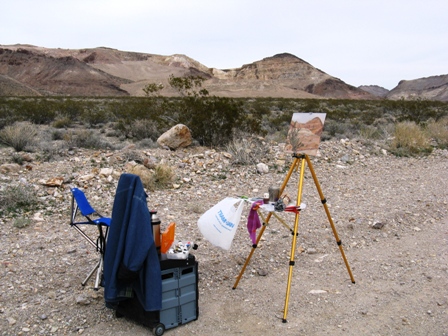 The most valuable bits in my gear are the clips. I have about 15 of them, all sizes and shapes, some plastic, some metal, and they all get used to keep things from flying across the desert.
I forgot to put up an obo for this painting session, but I did remember to pick up (and carry in my free hand) a rock for my semi-circle in the yard. And on the walk back to the Barn, I saw a desert bloom, or what I think must be a bloom. A few days ago I photographed a small plant whose leaves looked like viola leaves. Today I saw it “blooming.”
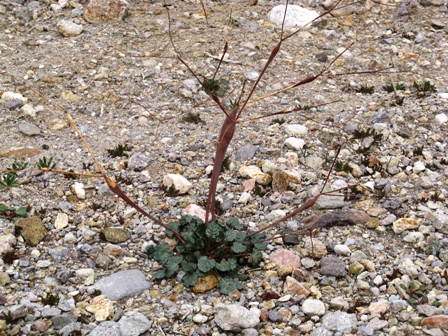 I thought at first that the spiky things might be old blooms or parts, dried and dead, but when I tugged at them, I could feel the life and strength that they held. I have no idea what they are.
I was happy to see the roof of the Red Barn, after doing two paintings. But the wind was gentle, the sun shrouded but putting out warmth, and the painting went well. The happiness was compounded by getting “home” after a hard day’s (well, 4–5 hours) of work. I rested, rehydrated, chatted up a couple of women from Colorado who donated some money to the Goldwell cause, and painted over the irritating painting of the Exchange Club in downtown Beatty. The painting didn’t work from the beginning and nothing I did made it any better. So now it’s a fresh board, ready for a new painting. I also gessoed some other boards and made notes about what’s next. And was sitting outside, drinking my last cup of tea when the little red Honda came charging up the road, right on time.
Here’s a last photo of the day, of the Bare Mountains (Route 95 follows them south) in the waning day’s light: I took it while I was sitting outside the Barn doors, sipping my tea, feeling satisfied.
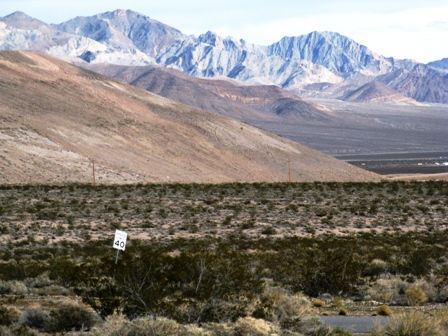 I left in the speed sign both because it amused me and also because it gave the photo program a white to work from.
Reported from the Goldwell House, in Beatty Nevada, USA, Northern Hemisphere, Planet Earth.
 juneunderwood.com
One response to “Diary of a Residency, Day 13, February 28, 2009”
[…] « Diary of a Residency, Day 11, February 26, 2009 Diary of a Residency, Day 13, February 28, 2009 […]