
It’s been a long winter (and just because it’s May, it doesn’t mean the winter is truly over.)
I spent most of my winter cooking, and if you are curious how someone who won’t/can’t/ doesn’t cook managed to do such a thing, check out recent posts on southeastmain.
However, during the winter and early spring I also had the good fortune to do a little art in the nearby southeast industrial district, where I managed a few on-site studies (January gave me some sun) and more studio canvases.
Portland Store Fixtures provided a studio in what we formally called “The Mezzanine level of the Second Floor of Warehouse C” or, more commonly, “The Garret.”
The Garret deserved its own portrait(s). My friend Jane Erskine, who drew in The Garret with me a couple of times, did black and white drawings of the space:
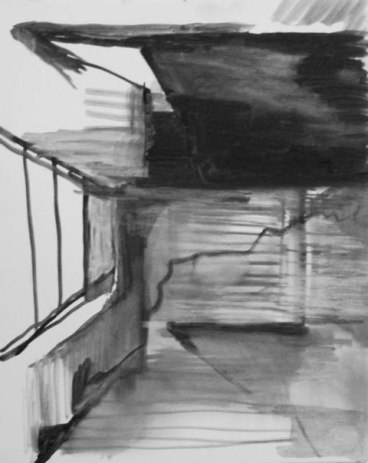 Jane Erskine, Garret 1, 20 x 16″, alcohol and graphite on canvas, 2012
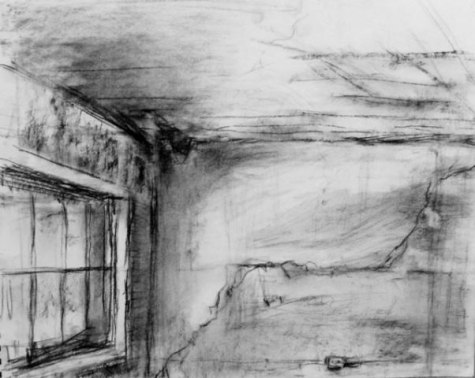 Jane Erskine, Garret 2, 14 x 18″, charcoal on paper, 2012
And I did a fairly good-sized oil painting of the same corner:
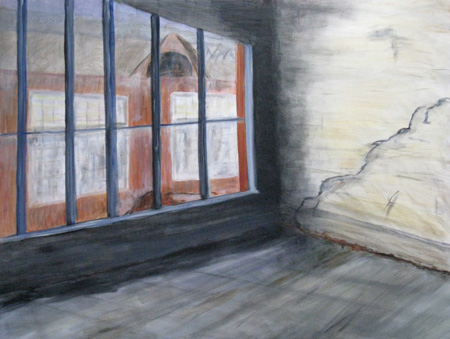 JOU, The Garret, 40 x 30″, oil on canvas, 2012
I wish I had recorded the sounds that accompanied these drawings. This space is directly over a garage (perhaps why it’s a “mezzanine” level) and off and on, the automated garage doors would be opened to allow an idling truck in and out. The whole room shook, shuddered, and roared when that happened.
The warehouse is half a block from the main tracks of the B&N railroad through the central industrial area; the trains are required to blow their moaning whistles (twice) at every crossing and there’s a crossing at every street corner, which meant we could hear them coming from a long way away, until it sounded as if they were about to broach the walls. Then they would moan their leaving — crossings on either side of the warehouse building, accompanied by the long low moans of crossings further up and down the track.
Then there were the conversations in the street below and from the warehouse across the street which houses artists and artisans of various sorts. The windows of The Garret had some large cracks, so we got various kinds of conversations, from technical discussion of truck unloadings to technical discussions of, well, personal matters.
Not to mention the sound of grocery carts loaded with transient’s gear being rolled along under the Hawthorne Bridge and the skateboarders’ whiz and bangs. And PSF workers in this warehouse have their own boom box on the second floor as well as some kind of stereo equipment on the first floor that were almost always playing music of some sort. They were sometimes in synch, but sometimes not, but since they were background to all the rest of the sound effects, they merely added to the general ambiance.
All in all, the painting and drawings tell a bit of a lie; the place never felt isolated and deserted, even though at first glance one might think so. We were accompanied by all the sounds of the industrial district community, and I for one loved the sense of secretly being a part of it all, while snugly playing with my oils in my secluded little room.
Plant 5 of the Eastside Plating Works (the canvas version) is almost ready for unveiling — I’m doing telephone wires and vehicles on the last of the 5 panels. Stay tuned. Spring is coming (so they say) and it’s time to finish these babies and get outside again. –June
 juneunderwood.com
4 responses to “The Garret, AKA the Mezzanine Level of Building C”
So, what about the smells of the location? That must be worth a story!
The smells — oh, dear. I think it was mostly dust. I’ll have to think about that. Occasional diesel, of course, but only occasionally. And the pervasive slight toxicity of an industrial area, very slight, so you mostly didn’t notice it. But dust — warehouse type dust. The loading dock doors were always open, regardless of the temps, so sometimes it was a bit dampish dust. But not mold, not bad, big, airy dust.
Um, can I paint dust?
A wonderful reminder that what gets captured by visual artists is only a small part of the experience, and often misleading. Also a reminder that the viewer brings his or her own experience to the work. “Every work of art is one half of a secret handshake…” (Michael Chabon)
Sheila,
Love the quote — half a secret handshake. Sometimes, the secret gets exposed just a little, too.