This post features Group Four of the five groupings of seventeen paintings I did at the northeast Arizona Petrified Forest National Park. The earlier three groupings on the blog are “Natural Monuments,” “Cultural Monuments,” and “Recent Developments.” The groupings were done partly to present relationships among the paintings and the environment and subject matter, and partly because they look good together.
This fourth grouping shows paintings from and of the Painted Desert, a place I initially confused with the “Petrified Forest” until I spent time there. The “Petrified Forest” describes the numerous, often huge, and mineralized logs that are so abundant along the southern half of the Park; they drew visitors as well as entrepreneurs to the area before it became a park, and their plundering was one important reason the federal government declared the area first a National Monument and then a Park. The petrified logs, stunning artifacts of a chemical “magic” of eroding badlands, exist outside the southern boundary of the park as well as inside it but diminish toward the north of the Park (click for a map). The Painted Desert is one of the primary features of Park, evident throughout although sometimes hidden under sand dunes, meadows, and a much later geologic formation, and it extends further north and west, almost to the border of Arizona and Utah. It is a different, and equally unreal, landscape from the grassy meadows and log-strewn lands a bit south.
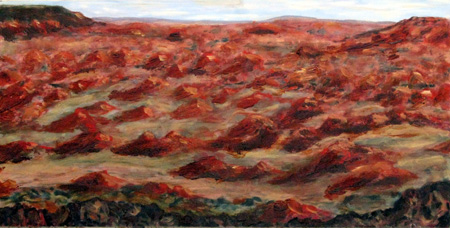
From Pintado Point (2) , 12 x 24″, oil on masonite, 2010
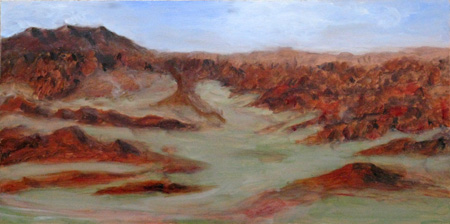
The painting above is the scene that captured me, again and again, a scene that breaks out when you round a curve in the drive north through the Park. It’s of a 225 million year old eroding landscape, one that changes color and shape with light and moisture, but is always, inevitably, breathtaking. And unreal, of course.
Here’s that landscape (different paintings of it) in context with other elements that surrounded me as I painted it: The Petrified Forest: The Painted Desert:
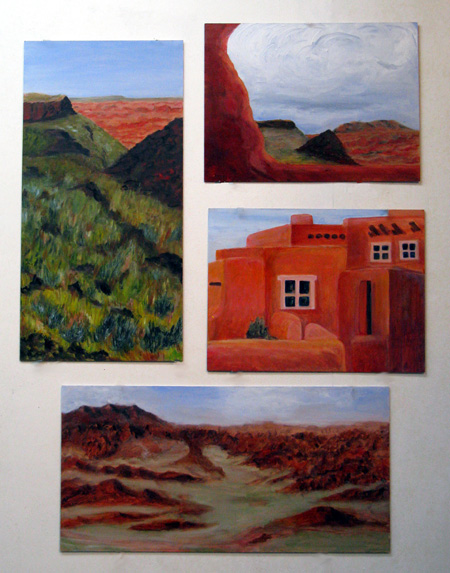 The Painted Desert (1), (The Bidahochi Formation; Inside the Painted Desert Inn; The Painted Desert Inn, north side; From Pintado Point –1) oil on masonite, 2010
I painted from inside the Painted Desert Inn on one stormy day. The wind was wild, the clouds fantastical, the sand grains covered my wet oils and blew my paintings around the covered but open-windowed patio. The next day I painted the outside, to the north, of the Inn, finding that capturing the multi-roofed and layered façade a challenge equal to capturing the multicolored badlands. Earlier that same day, I painted on the western side of the Inn, toward the trail that leads directly down into the eroded landscape, a badlands that contains washes that led travelers through the territory at least as far back as humans were making petroglyphs. (I didn’t paint the petroglyphs, but have it on good authority that they exist in large quantities on the desert varnish of the rocks in the painted desert.) And the bottom painting is a version of the vast badlands, with less red, that begins this post, a painting done from Pintado Point, on a different day, with different colors, but still having the same power.
The Painted Desert Inn, which is the Spanish Revival gift shop and entry point for a couple of hiking trails, is a product of the 1930’s depression-era Civilian Conservation Corps. The dark rocky shapes seen from the Inn’s patio are parts of the Bidahochi Formation, a relatively young geologic feature of some 10 million years of age, which sits on top that 200 million-some year old eroding Chinle formation. This unconformity gives the casual visitor (and some more serious ones) a word that captures something of the strange nature of this national park: the Petrified Forest National Park is not a single thing, nor a double nor triple thing. It’s a series of “unconformities.” The word means a disjuncture of geological formations, like the 10-million year old element sitting right on top of the 225 million year old element, with no formations in-between. It’s a jarring thought, but inescapable.
For me, the Petrified Forest National Park is one unconformity after another, “unconformity” used more generally than in its geological sense. PEFO’s focus, unlike most national parks, is not just on landscape or geology or geography, not just on chemical processes that turn wood into minerals nor long departed cultures with sophisticated buildings nor more recent national monuments. The Petrified Forest National Park is about all these things. And the scenes that I painted became more and more involved with capturing this large number of disparate elements, these unconformities.
Unconformities, landmarks, bits of older and younger geologies and cultures — all intermingled, all bumping against one another, each giving the other a slightly different and larger meaning and context. –June
The continuation of this post shows the individual paintings in Group Four.

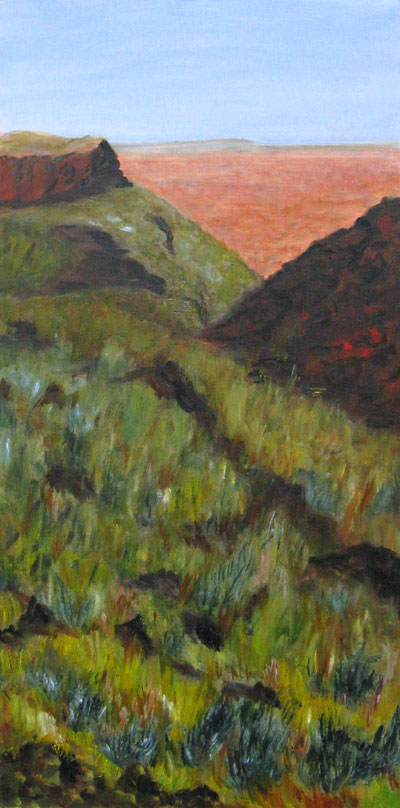 The Bidahochi Formation overlooking the Chinle Formation, 24 x 12″, oil on masonite, 2010
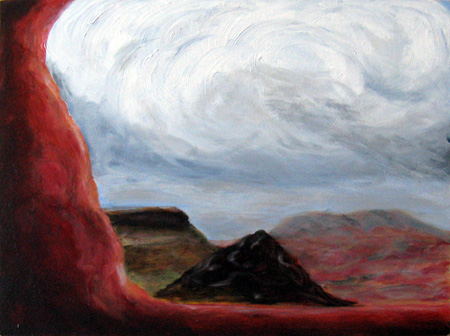 The Painted Desert Inn: Approaching Storm, 12 x 16″, oil on masonite, 2010
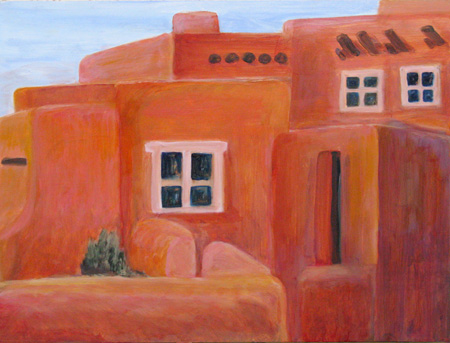 The Painted Desert Inn, North Side, 12 x 16″, oil on masonite, 2010
 juneunderwood.com


2 responses to “The Petrified Forest: The Painted Desert (1)”
Would you know any thing about a watercolor or painting from the 1930s called “The Painted Desert” from Lipan Point by K.B. 1930 copyright? Or do you know where I should look to find info on it.
I know nothing about such a watercolor. If you find it, let me know. I’m assuming you’ve already done an internet search. Do you know if K.B. was an oregonian. If so, you might try the Oregon Historical Society, querying through email. And the Multnomah County Library, another email query. The library is always eager to help. There might be a watercolor society in Portland, or an artist society derived from what was once a watercolor society. I’m trying to dredge up my memory of that and what it might be called now. If I think of it, I’ll respond again. I’m very interested, in fact.