
I had originally thought to make a somewhat rectangular whole of these 17 paintings from the Petrified Forest. I planned to surround the paintings of the human developments with paintings of the natural landscape. However, the resulting conglomeration of paintings was too large and didn’t hang together, visually speaking, very well.
However, when I set the paintings up along the wall of the studio, they fell easily into groupings that were smaller, more comprehensible, and visually more satisfying.
The title of today’s grouping, “Recent Developments” was provided by Jer, with a sly wink.
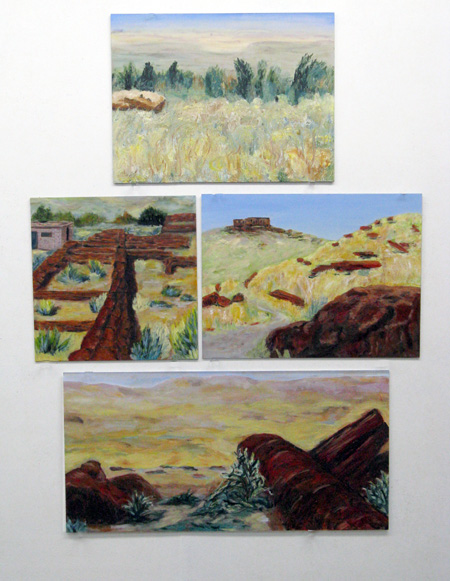 The Petrified Forest, Recent Developments: Puerco River Meadow, Puerco Ruins, Agate House, Long Logs Trail, 12 x 12″, 12 x 16″, and 12 x 24″, oil on masonite, 2010
The “recent” developments in this grouping are the Puerco Ruins, Agate House, and a concrete block restroom. The first two are remnants of the Puebloan people who inhabited the area around 1250. Jer’s wink was also an acknowledgement that Agate House was “reconstructed” by the Civilian Conservation Corps in the 1930’s; it is not authentic, although it uses the original Puebloan materials, in this case the mineralized logs which are so abundant in that area of the Park. Agate House sits on a high hill, originally perhaps for safety reasons, but also its reconstruction made it very visible to early Park visitors.
The Puerco Ruins, made of sandstone and part of more recent ideas about historic and cultural preservation, are part of a large compound of residences and religious remains, including a kiva. The remains are extensive but mostly now covered over with soil by preservationists who found covering ruins in this high dry climate protected them well from both weather and humans. I was bemused by the Park Service’s abandoned restroom next to the walls of the Puerco Ruins. It is an even more recent development, as well as being a kind of ruin. I suspect that this concrete extrusion will be removed in the future. But there it was, sitting right next to the ancient sandstone walls.
The Park’s Long Logs Trail (bottom painting in the grouping) shows off the petrified wood; it overlooks the plain upon which the Agate House is situated. And the Puerco River meadow (top painting) is a view from the Puerco Ruins; the lush meadow is presumably one of the reasons that the Puebloans settled the area.
This grouping is, of course, “cultural” and could have easily been titled “Cultural Monuments.” But the sense that one gets in doing plein air in the area is of a way of life that was part of the landscape instead of plunked down on it; the irony of Jer’s titling of the “developments” is that they don’t exactly look like suburbs. Of course, the ruins have had hundreds of years to sink back into the soil and when there were hundreds of people living their lives in the meadows, they may had a very different aspect.
Again, I was trying, in these paintings and in this grouping, to provide something of the sense of how the “landscape” with all its attributes, human and natural, historical and geological, was part of what I was experiencing. The experience which the scene provides the artist, for me, is intrinsic to what the artist gives back by way of painting. It isn’t my vision, nor is it a photorealistic depiction, but rather a set of relationships, mental, visual, experiential, environmental, all of which combine for me while I’m painting and when I review the paintings. By setting them into groups, some of the larger forces that I was feeling might be available to the viewer. –June
The continuation shows the individual paintings.

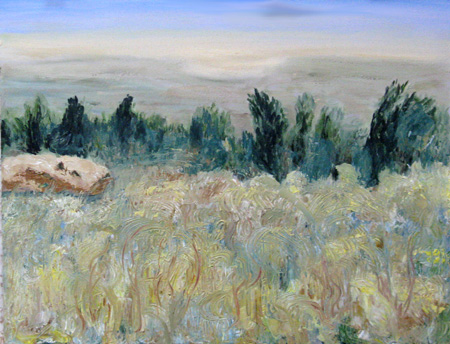 Puerco River Meadows, 12 x 16″, oil on masonite, 2010
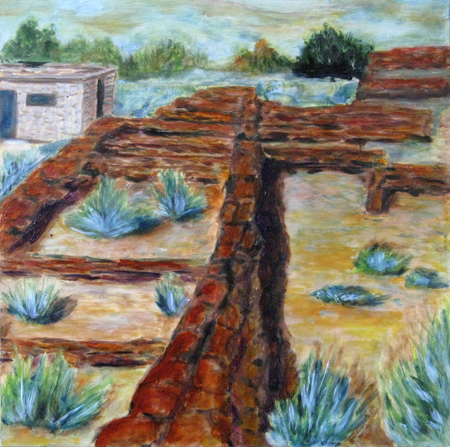 Puerco Ruins, 12 x 12″, oil on masonite, 2010
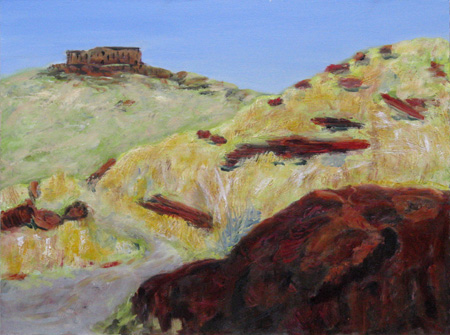 Agate House, 12 x 16″, oil on masonite, 2010
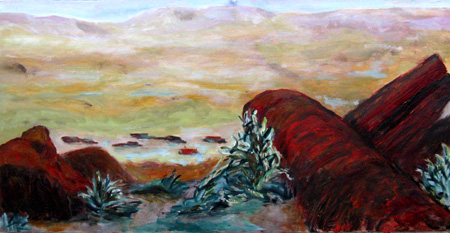 Long Logs Trail, 12 x 24″, oil on masonite, 2010
For further information on the Petrified Forest, click here. Note the photo of the Puerco Ruins; luckily the sky had nice clouds the day the photograph was taken.
 juneunderwood.com


