
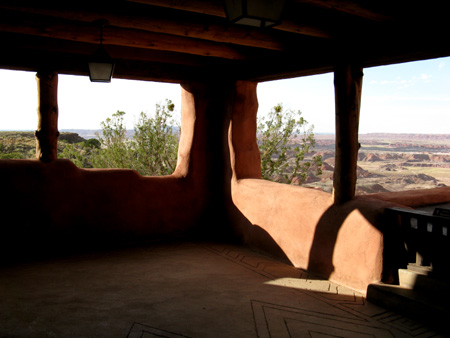
I have no painting to show today, what with rain, hail, and demos at the Painted Desert Inn. Not to mention tourists freaked out by flooding and wild weather at the Grand Canyon and tornadoes at Flagstaff. All in all, I was grateful for my “studio” in the enclosed and roofed upper patio space at the adobe Painted Desert Inn, although I’m claiming the painting I did was plein air — after all, there was plenty of air in this space without windows:
 The painting I did is stashed in the ladies room at PDI, which is without water at the moment and so unused. It will make a good storage space for the next few days.
The space shown above is open to the public, yet out of the main path of tourists wanting to know where the bathrooms are (porta-potties, outside) and where the petrified wood is (down the road apiece). So I got to chat up those interested in the landscape and or/the paintings. It was entirely pleasant.
This is how the landscape looked at 11, when Jer and I just narrowly missed a pouring hail and thunder-storm. We went to set up the “exhibit” a bit earlier than I had to be there, and the sight of the desert through the rain was startling. And beautiful.
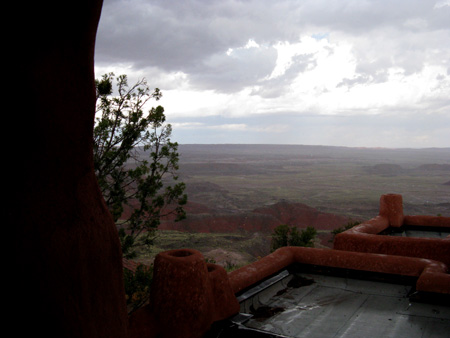 I became very aware of the adobe surfaces of my space as I painted the view beyond them. In that painting , I incorporated a bit of the adobe to frame the view. Looking at the adobe walls to paint them I was suddenly struck by the realization that the adobe had been hand-troweled onto the walls, troweled by guys the age my father was when he broke rocks for the Pine Creek road with the CCC. The Civilian Conservation Corps (run by the military) was part of the Great Depression’s federal work corps, made up of more than 3 million young men who had to have at least 3 teeth, were provided with room and board, and were required to send home $20–$25 a month of the $30 they made — this money not only aided families but put more money into the economy to help slow its downward spin (The pay amounts apparently differed from place to place, or at least the stories of the pay differ; the requirement that most of the money get sent home is always included).
Dad didn’t trowel adobe, but the beauty of the building had to have come from boys like him who built roads and trails in parks, constructed conservation dams, made campgrounds, planted trees, drained swamps, replanted grazing land, renovated historic buildings and strung telephone lines. Many of these things still exist and are part of the utility and beauty that we all still enjoy. I found touching the walls a moving experience.
But of course, mostly I chatted up the tourae, and painted a bit between times. Chatting up people is something I do pretty well, but I also find it totally exhausting. Jer practically had to carry me home. Once we got here, he went out to the gas station and brought back six variations of an ice cream sandwich (all they had), which tided me over until dinner. Well, I didn’t eat all six — after all, I have to go back and chat tomorrow, too.
Here’s the view, of Pilot Rock and the Bidahochi Formation, that I painted at while gabbing away:
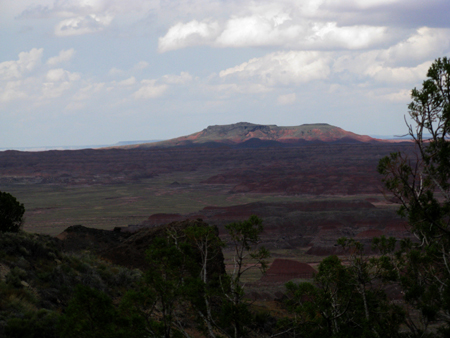 The camera’s ratio didn’t allow for the adobe to show up in the photo, but my handy-dandy plastic viewfinder, a tool I’ve become totally reliant upon, showed this view and the adobe wall to the left. The sun kept playing footsie with the clouds, so all day different bits of the landscape would shine into view and then be eclipsed by shadow again. Pilot Rock is lit by sun in this photo; the bit of rock face to the far left center is the Bidahochi. More about its interesting characteristics when my brain is functioning a bit better. I’m going to bed.
From Apt K at the Petrified Forest National Park, a grateful tired artist –-June
 juneunderwood.com
One response to “Petrified Forest Residency, Day 11, Oct 6, 2010”
I’ve probably mentioned that my dad was in the ccc – stationed at Pactola in South Dakota before a dam went in and flooded the area. He did a lot of tree planting and told stories of tying the young saplings in a knot before sticking them in the ground. He took me back to the area and I know he was looking to see if he could spot the results of his prankstering. Yes, the bulk of his pay went back to his sisters – their mom had died, their dad deserted the family and my dad traveled all over looking for jobs to keep his sisters from being split up in foster care. Built roads with the WPA and then really got saved by the ccc program which also gave him the opportunity to take correspondence classes. Those boys did wonderful work all over the country.