Petrified Forest: Day 3, Sept 28, 2010
6 AM:
I did my early morning painting at Blue Mesa, a 3 mile loop road in the center of the park with a short hiking trail attached. Jer walked the whole trail. I walked a short way, until I spied a hoodoo, one of those rock formations that are balanced weirdly, with various harder and sometimes larger rocks sitting on top of softer, screed and eroding materials below. The process is called “differential erosion” and the rocks often look as if they are leaning, just about to fall. In fact they will fall; for example, the petrified trees have mineralized into harder rock than the ubiquitous sandstone of the Chinle Formation, and they can be found lying like bridges (“Agate Bridge” is the name of one such formation in the park) across hummocks of softer rock. Eventually the underlayment erodes away and the stone tree falls.
The hoodoo rock at Blue Mesa did not have a stone tree, but was eroding in such a way as to unbalance it.
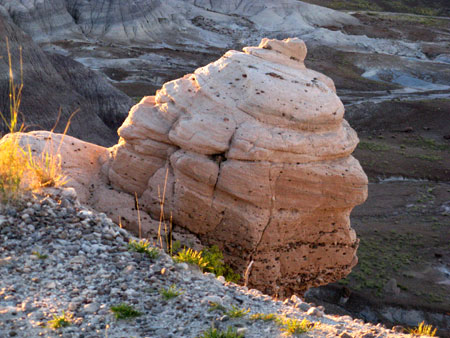
Photo of Blue Mesa Hoodoo, 5:50 PM, September 27, 2010. Here’s how it looked at 6 AM:
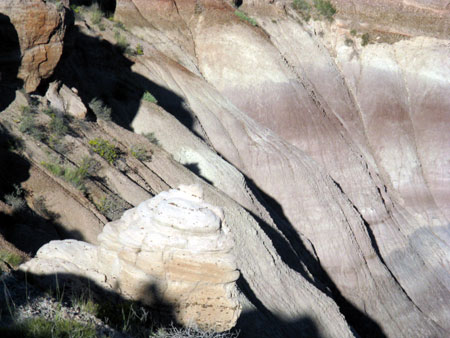
Photo of Blue Mesa Hoodoo, 6 AM, Sept 28, 2010
The colors change radically around here and are often wildly at odds with what one expects. The surface features, both the softer rocks as well as the hard petrified trees, can have wonderful, and wonderfully variable colorings. The desert sky, the time of day, the presence of clouds, as well as the nearby rocks and degree of erosion account for the various colors. When I saw Blue Mesa at 6 AM (when I had expected dramatic shadows and color), I had some second thoughts about rising at 5:30 to see the washed out hoodoo. Nevertheless, it was there — and so was I. And so I painted it.
I used more titanium white than I have ever done, basically covering the entire board with a light layer of white and then adding color. The hoodoo was particularly white, with some banding of soft ochre or gold in some of its strata. It was also off-balance, with scree underneath indicating an eroding base.
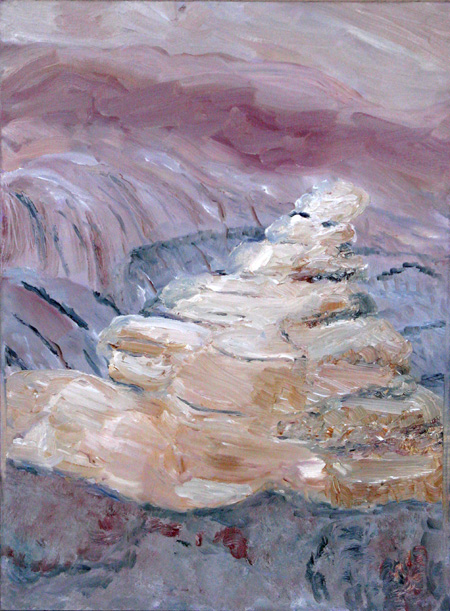
Blue Mesa Hoodoo #1, 12 x 16″, oil on masonite, 2010
This is one of those paintings that I knew before I stopped would need more work under better conditions. I had my back to the sun, which meant a great glare on the board. And the amount of white paint on the board prevented much value change — titanium white oil paint is a great leveler of light and dark.
By 10 AM, when we left, the area was far more colorful, albeit still muted. I would have expected the opposite, as a higher sun generally washes out color. I can’t account for the difference in perception. The hoodoo gained a bit more color, although not a lot; but the hills behind it, taller, banded, and eroding, had more color to them at 10 than at 7 AM.
Today the concept of layering (various colors are caused by different minerals as well as different conditions under which the soil-turned-rock was laid down) has caught me (like “collaging” got me thinking yesterday). Most of the rock, however banded and colored, was laid down in the same period and seems to be mostly sandstone, of varying consistency, and conglomerates, both of which erode readily, albeit differently, depending upon conditions and kind of sandstone and conglomerates. (The stone “trees” have a different composition, much harder and heavier than the sandstone/conglomerate materials). So layers are uncovered in different ways, depending upon the overlying level of rock and the nature of erosive weathering agents.
Later Periods, the Jurassic and Cretaceous, and the early Cenozoic Era seem to have been washed away (or disappeared in some fashion), although some late Cenozoic Period material is left as cap rock in a few places. The late stuff is mostly lava and ash, and sometimes holds the sandstone in place, capping it.
This break in the geologic record is known as an “unconformity,” a great word, which could be used in other contexts besides the geologic. For example, evidence of early peoples has been found, beginning about 10,000 years ago, with records extending through about 1300 AD. Then a human unconformity within the park appears until some early white travelers — Spanish explorers, mountain men, and surveyors from the east – hundreds of years later, leave written records.
[I must add that the human unconformity is not seen as such by the indigenous peoples, such as the Hopi, who say that their ancestors lived here, but moved on to other places when new needs arose. Scientists now more or less agree with the Hopi understanding. Moreover, it is only within the Painted Desert and this region that the record disappears. It continues elsewhere.]
Hence an oxymoron: layering provides a time-line, oldest on the bottom, younger on the top. But unconformities muck up the time line, leaving great blanks. The blanks remind me of the Arizona skies, which are great washes, fading into altered colors so gradually as to be imperceptible, until Bang, a black table-shaped form asserts itself against the washed out void. An unconformity, a transition that doesn’t happen.
Another metaphor appears in Pages in Stone, by Halka and Lucy Chronic: “Single layers in the Chinle Formation are not extensive and are in many places replaced horizontally by strata of different color, grain size, or bentonite content.” (Italics mine)
Human layers likewise seem sometimes to be replaced, horizontally – trails replaced by rails replaced by primitive roads, replaced by Route 66 (much touted within and without the park), replaced by the utilitarian Interstate 40, underlain by Park Service roads which replace older PS roads which replaced tourist and commercial rock gleaners roads.
Layers, Replacements, Unconformities. Aren’t words wonderful. They seem at times to be extremely efficient in making concepts clear?.
But painting is at least as much fun, even if somewhat more challenging to make work conceptually. The “utility” in painting is in its visual attributes, pulled from internal visions and abilities, and if you are working plein air, from having the external scene always in your face. Replacement of Davy’s Gray with Terra Verte happens as the light changes, and then there are the blanknesses that occur when nothing can be painted. And of course, the layers of colors within the rock are echoed by the layers of understanding of the colors in the artist’s brain which is also layered by comfort and discomfort, water or thirst, heat and cold, and so each painting contains layers, and later paintings play off against earlier ones, creating layers of meaning.
In other words, I find myself working personal layers on layers, replacing hues as the colors changes before my eyes, and seeing great unconformities, blankness where there should be something placed on the canvas. These are today’s maunderings amongst the hoodoos of Blue Mesa.
We returned to Blue Mesa about 4 PM. Jer read Tony Hillerman in the sun shelter while I found a different set Hoodoo rocks on other side of trail. I did close-up view, and the shadows were a bit deeper and the colors more vivid. I feel better about this painting than I do about the one I did this morning.
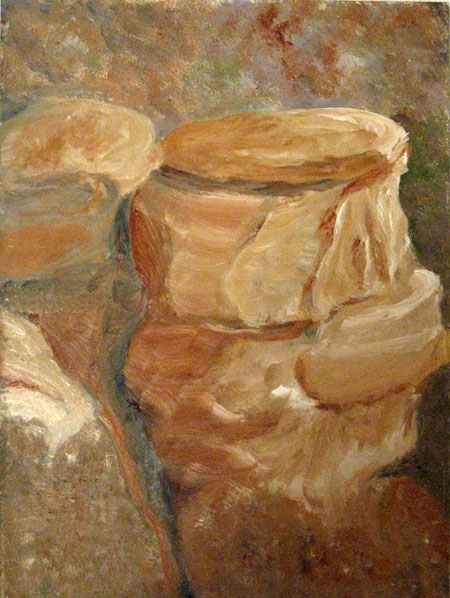 Blue Mesa #2, Evening, 12 x 16″, oil on masonite, 2010
As we have been told again and again, the colors change here — and change rapidly. I had just finished putting away my gear when suddenly a golden sunset light struck. It stayed around less than 15 minutes and I had no energy nor equipment ready to work with it. To capture that light in paint would be amazing. And amazingly difficult if one didn’t work from photographs, which I’m reluctant to do. But necessity is the mother of more than invention, so I’m told. We’ll see.
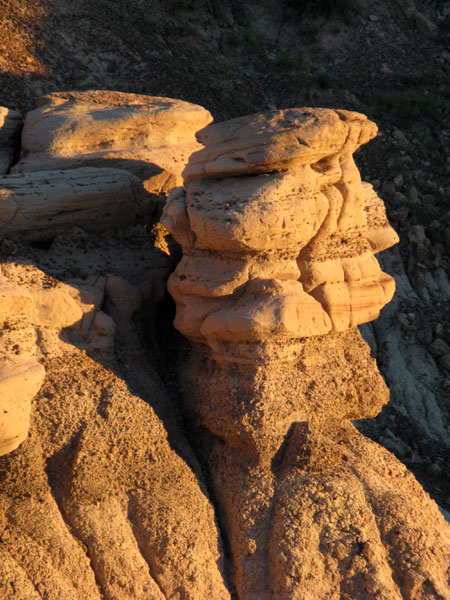 Above is the photo I took of my painting scene at about 6 PM, just as the sun was about to set.
I have set Sunday aside as the day to work on the paintings here at the apartment (we have a nice outside patio that will serve as a studio). Tomorrow, it’s off to Tawa Point.
Reported from Apt K, Petrified Forest National Park, written and photographed on Sept 28, 2010. –June
 juneunderwood.com
One response to “Petrified Forest Residency, Day 3, September 28, 2010”
and, if you pick up the right rock you can be holding millions of years in your hand. Joy and wonder!
(Be sure to put the rock back down after contemplating it.)