Only 30 days left in our stay. I begin to panic. Thus far, and yes I’m counting because there’s safety in counting, I seem to have some art produced for every day, plus one rejected board. That count includes the bad woodcut where I over-reached on the second day of the workshop.
I’m feeling a bit exhausted by it all. I have only about 5 small (12 x 16) boards left — maybe five 18 x 24 — and three 18 x 36 boards left. Plus a large roll of canvas. The small boards are by far the best for plein air work because they can be painted quickly. So I think I will get a stapler to staple canvas to stretchers, and order some 12 x 16 stretchers from Las Vegas Dick Blick. George Radomski, new proprietor of the Lost River Trading Post [ultimately called the Beatty Mercantile], is thinking of having some of the downtown paintings in his store and they should be hangable. [ed note: George figured out how to hang the masonite boards without me having to deal with stretchers and canvas. Whew!]
When we are on the road, the small painting boards are very useful. I can do plein air around the studio and even in Beatty with the larger ones, though, so that might fill in a gap. The Barrick Mine pyramid and mountain and buildings off route 374 will be a larger project for one longer board. Perhaps the Bare Mountains, with the speed limit sign, is another possibility for the long panorama. It can be done from the Barn. There’s always the playa, the Amargosa Valley, which stretches out in front of the Barn doors. I did a nice early version of this on a small board; moving to a bigger one is enticing, but also dangerous.
And then there’s the back wall project(s). Mercy, only 30 more days!
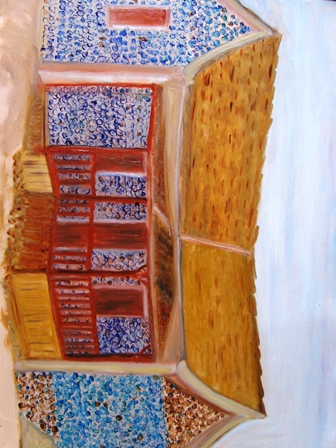
So today I painted at Rhyolite, the nearby ghost town, working up the Bottle House. Betty, the Volunteer for the BLM, expressed a desire for such a painting and so I am doing one for her. The best photo of the Bottle House is on the Rhyolite Wikipedia page, but I have one (of about 35) that I took for reference purposes that shows it pretty well:

The Bottle House is made of 50,000 or so glass items, 90 % of which are beer bottles. Many of those are from an early Adolf Busch bottle-making concern (there are stamps on the bottoms which can be read and researched). Even the foundation of the House is built of bottles put together fat end next to skinny end. The house was built in six months in about 1905, raffled off to a family, was lived in off and on for some years, had a silent movie made at it (and the movie makers restored it a bit), almost fell to ruins and was saved by the Beatty Preservation Association and the BLM, which put on the new roof. A number of artifacts collected from around the area are enclosed in the heavy duty fence that keeps out the public when the caretakers, Betty and Fred aren’t around.
I wasn’t much interested in the Bottle House — a bit too Disney-fied for my mind, I thought. But Betty asked and after hearing her spiel about the house, I decided it was only the roof that made it too pretty and that would probably weather nicely after a while in the sun.
What catches me about the Bottle House is the imagination and verve of the guy who built it. It has some interesting detailing, aside from the bottles:
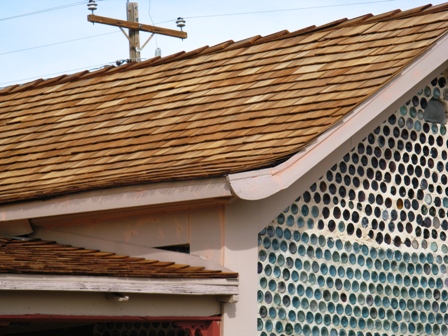 The curve on the edge of the roof is very eastern in feel, and the builder, Tom Kelly, was from Australia. So perhaps he was influenced by his origins. Or perhaps he was part of the interest in things Japanese at the turn of the century. Or maybe he just like carved wood. Whatever his motivation, clearly, building a house from beer bottles took time, skill, and some kind of wondrously weird desire. The ceilings are ten feet high, but the house was plastered inside, so the color of the bottles didn’t seep through the walls. Go figure. Kelly didn’t even recover his costs; he spent $2500 making the house and his raffle brought in only $2000. And he never lived in the house.
The painting that I did was done inside the fence, with Betty and Fred keeping a close eye on what I was doing. And many many tourists also viewed the work, but most didn’t ask questions.
I worked until from 10 to 2 and then went back to the Red Barn, stopping along the way to get reference photos for my Shorty Harris painting:
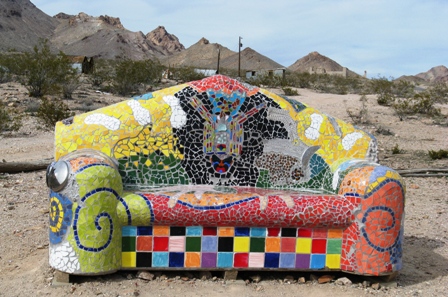 This is Sit Here, by Sofie Siegmann, rescued in 2007 from Las Vegas. I want to paint it next to Lady Venus so she can sit down when she needs to.
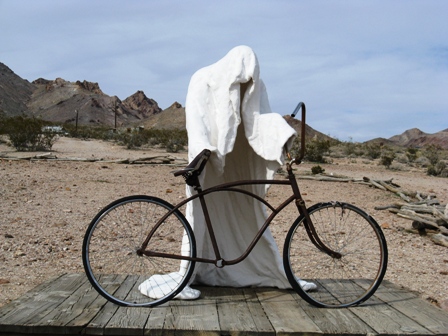 This is Ghost Rider, by Alber Szukalski (1986). It is Szukalski’s work that is the base for the rest of the Goldwell Open Air Museum — he placed this and his Last Supper here and invited friends to contribute. When he died, the Goldwell Foundation inherited all the artwork as well as rounding up a bunch of land and the Red Barn. I needed this reference photo because my poor ghost rider looks rather like she’s working on a spinning wheel. So I need to make her activity more clear.
And then, back at the Barn, I put in the bottles on the House which I had spent 3 hours painting on site. Betty’s brilliant suggestion was to use a pencil eraser as a stamp to make the circles for the bottles. This I did. The old Mesquite tree, 2 feet tall when the House was built, has yet to be installed in front of the House. But the rest is pretty well finished. I have to decide whether to include the utility pole. I might do it, off to one side, using a tad of artistic license to balance the painting. But the painting itself is well on its way and I’m glad.
 Reported from the Goldwell House, Beatty Nevada, this first day of March, 2009.
 juneunderwood.com